

The Hemon Framework: How to Score Your Marketing Before You Ship It
Most marketers ship copy and wait for the data to tell them whether it worked. By then, you've spent the ad budget, the email went to 10,000 people, and the landing page has been live for a week.
The professionals score it before it ships.
This is the Hemon Framework. It's the diagnostic system that separates copy that will convert from copy that won't, before you spend a dollar testing it. If you're shipping marketing at volume, this is how you maintain a quality standard without hoping.

What the Hemon Framework is
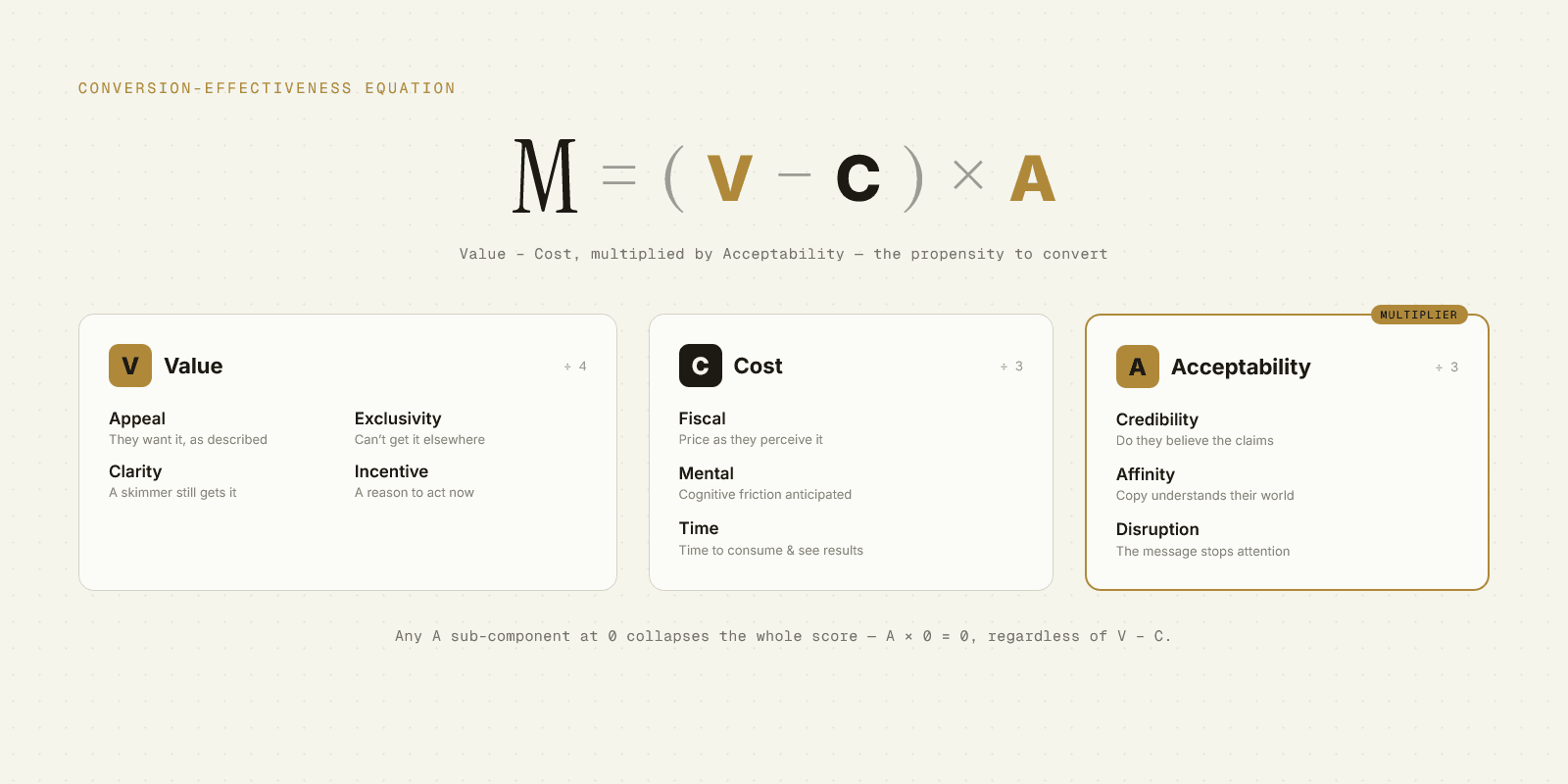
The Hemon Framework is a conversion-effectiveness equation:
M = (V − C) × A
Where:
- M = Marketing Effectiveness (propensity to convert)
- V = Value (perceived benefit the prospect anticipates)
- C = Cost (perceived friction between prospect and benefit)
- A = Acceptability (whether the prospect notices, believes, and connects with the message)
It's not a creativity rubric. It's not subjective. It's a structural diagnostic that tells you exactly which component is pulling your score below threshold and what to fix.
Why the Equation Is Multiplicative (Not Additive)
A is a multiplier of (V − C), not an additive component.
If any sub-component of A approaches zero (the prospect doesn't stop scrolling, doesn't believe the claim, doesn't connect with the tone), the entire equation collapses regardless of how strong V − C is.
A perfect offer the prospect never sees converts identically to a terrible offer the prospect never sees: zero.
This is why diagnostic priority is A before V − C. You don't fix Value or Cost issues on copy nobody reads.
The Ten Sub-Components (What You Actually Score)
Each top-level component decomposes into independently diagnosable, independently fixable sub-components. The framework's operational power lives in this decomposition: you don't “improve the copy generally.” You repair the specific sub-component pulling the score below threshold.
Value (V) — Four Sub-Components
1. Appeal
Whether the prospect emotionally wants what you're offering, as described. Not whether the product is good — whether the copy makes them feel desire.
2. Exclusivity
Whether the prospect can get something they'd perceive as equivalent elsewhere. If they can, Exclusivity approaches zero regardless of how good your offer is in absolute terms.
3. Clarity
Whether a prospect who skims (not reads) would understand what this is and what it does for them. Ambiguity reduces Clarity even when the offer is strong.
4. Incentive
Whether there's a specific reason to act now rather than later, beyond the core offer. Generic urgency (“limited time!”) is functionally absent Incentive; specific scarcity or specific deadline is real Incentive.
Cost (C) — Three Sub-Components
1. Fiscal Cost
The financial price as the prospect perceives it — including whether you've reframed it against the cost of the status quo or the cost of inaction, or left it as a raw number the prospect must rationalize alone.
2. Mental Cost
The cognitive friction they anticipate: implementation complexity, uncertainty about what happens after purchase, decision fatigue from comparing alternatives.
3. Time Cost
The time they anticipate investing — to consume the product, to see results, to implement what they buy. Reduced when timeframes are specific and contextualized against time they're currently wasting on the unresolved problem.
Acceptability (A) — Three Sub-Components
1. Credibility
Whether the prospect believes the claims. Anchored by specific, verifiable proof elements: numbers, named results, testimonials with identifying details, time-bound outcomes. Adjectives are penalized; specificity is rewarded.
2. Affinity
Whether the prospect feels the copy understands their world. Tested by whether the tone matches their vocabulary and emotional register, not your brand's marketing voice.
3. Disruption
Whether the message stops their attention. Tested by whether the hook would interrupt this specific avatar's scroll or scan on this specific platform — not whether the hook is “interesting” in the abstract.
How to Calculate the Hemon Score
Each sub-component is scored 0 – 10.
V Score = (Appeal + Exclusivity + Clarity + Incentive) / 4
C Score = (Fiscal Mitigation + Mental Mitigation + Time Mitigation) / 3
A Score = (Credibility + Affinity + Disruption) / 3
The C Score reflects mitigation strength — higher mitigation means lower perceived cost.
The Formula
V−C Differential = max(0, V Score − (10 − C Score))
Hemon Score = (V−C Differential × A Score) / 10
Output is normalized to a 0–100 range.
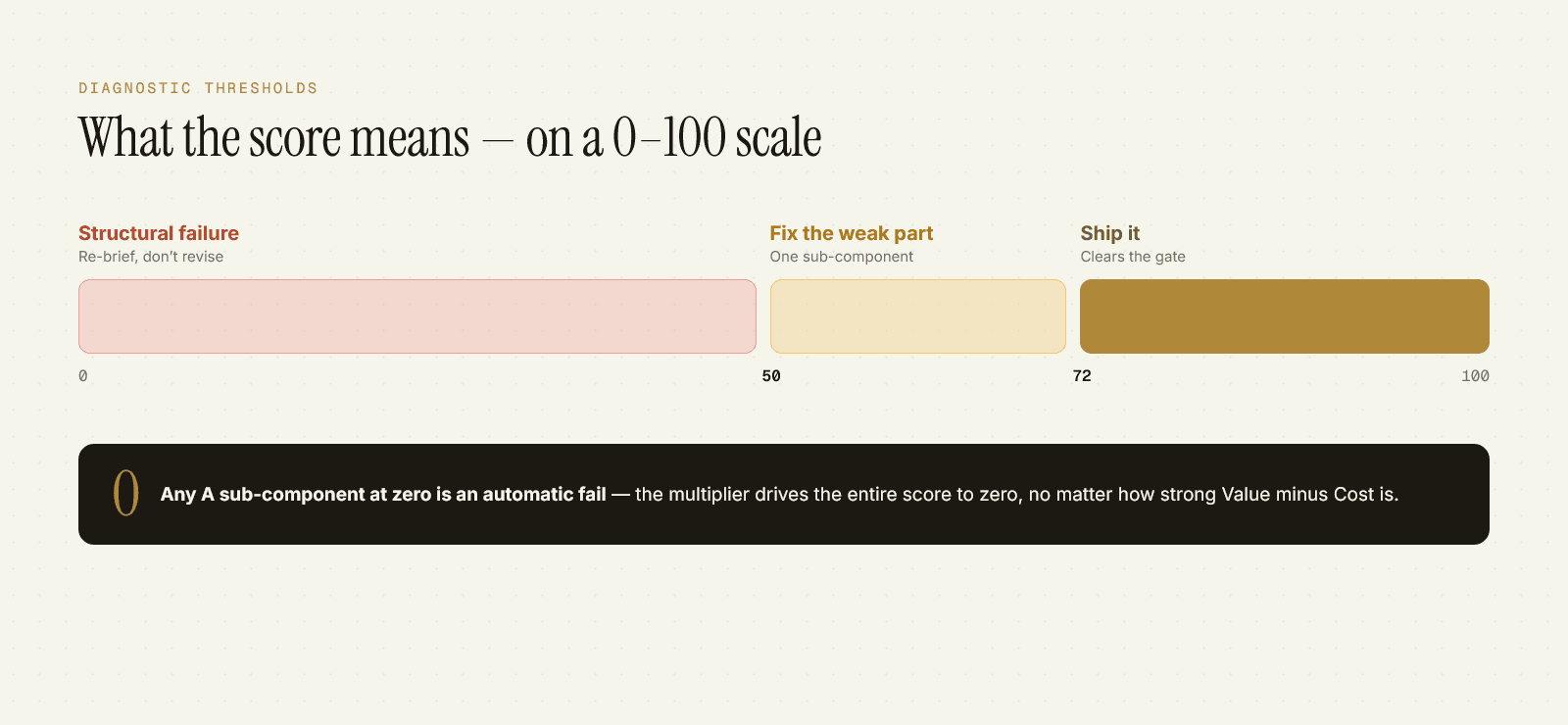
Diagnostic Thresholds (What the Score Means)
Channel-Specific Weight Adjustments
The framework's structure is universal. The weighting of A sub-components shifts by channel.
Channel Weight Adjustments
Facebook / Instagram / LinkedIn / Google Ads — Disruption +30%, Clarity +20%
Email — Affinity +30%, Appeal +20%
Landing Pages — Credibility +25%, Incentive +25%
Video Scripts — Disruption +40% (first 3 seconds), Appeal +20%
SMS — Clarity +40%, Time Cost mitigation +30%
Blog / SEO Content — Clarity +30%, Credibility +30%
Why this matters: A Facebook ad that scores 68 overall but has Disruption at 4/10 will fail in-feed regardless of the total. An email with Affinity at 3/10 will delete regardless of Clarity. The channel tells you which sub-components are load-bearing.
Worked Example: Scoring a Facebook Ad
Ad copy
Headline: Stop wasting time on marketing that doesn't convert.
Body: Our AI-powered platform writes your emails, ads, and landing pages in your brand voice. Built-in frameworks. No more re-briefing. Join 400+ marketers shipping faster.
CTA: Start free trial →
Scoring Each Sub-Component
Value (V)
Appeal = 7 (marketers want speed and quality, but the phrasing is generic)
Exclusivity = 5 (AI marketing tools are saturated; “built-in frameworks” is the only differentiator)
Clarity = 8 (skimmable, clear what it does)
Incentive = 3 (no specific urgency or scarcity)
V Score = (7+5+8+3)/4 = 5.75
Cost (C)
Fiscal = 6 (“free trial” mitigates price concern but doesn't reframe cost)
Mental = 5 (uncertainty about setup and learning curve)
Time = 6 (implies speed but doesn't quantify time saved)
C Score = (6+5+6)/3 = 5.67
Acceptability (A)
Credibility = 6 (“400+ marketers” is specific but not independently verifiable; no results mentioned)
Affinity = 4 (“wasting time” is generic pain language, not prospect-specific)
Disruption = 5 (headline is problem-aware but not pattern-interrupting)
A Score = (6+4+5)/3 = 5.0
Calculate the Score
V−C Differential = max(0, 5.75 − (10 − 5.67)) = max(0, 5.75 − 4.33) = 1.42
Hemon Score = (1.42 × 5.0) / 10 = 0.71 → normalized to 7.1/100
Diagnosis
Score: 7.1/100 - Structural failure.
Weakest sub-components:
Affinity (4/10) - “wasting time” is marketer-speak, not how prospects describe their pain
Incentive (3/10) - no reason to act now
Disruption (5/10) - headline doesn't stop the scroll
Fix priorities
- Replace “wasting time” with verbatim prospect language from reviews/testimonials (raises Affinity to 7+).
- Add specific scarcity or deadline (raises Incentive to 7+).
- Test a pattern-interrupt hook (“Your custom AI still needs babysitting” vs. generic problem statement).
Re-score after fixes. Target: 50+ minimum, 72+ to ship with confidence.
The Three Most Common Failures (And How to Spot Them)
1. Zero-A Collapse
Symptom: Total score looks passable (40–50 range) but one A sub-component is at 0–2.
Cause: The multiplicative structure means A×0 = 0 regardless of V−C.
Fix: You can't compensate for missing Credibility with stronger Appeal. Fix the A sub-component pulling the multiplier to zero.
2. Owner's Bias (Affinity Failure)
Symptom: Affinity scores 3–5 consistently across drafts.
Cause: Copy uses brand-side language instead of prospect-side language. You're writing how you describe the product, not how the prospect describes their problem.
Fix: Pull verbatim phrasings from reviews, testimonials, support tickets. Replace your vocabulary with theirs.
3. Value Without Exclusivity
Symptom: Appeal scores high (8+), Exclusivity scores low (3–5), overall score stalls at 50–60.
Cause: The prospect wants what you're offering, but they can get it (or perceive they can get it) elsewhere.
Fix: Surface the unique mechanism. What does your solution do that alternatives don't? Make Exclusivity explicit in the copy.
Why This Framework Exists
Most marketing teams operate on feel, best practices, and post-launch data. That works at low volume. It breaks at high volume.
If you're shipping 20 emails, 40 ads, and 12 landing pages in a quarter, you need a pre-flight diagnostic that tells you what will work before you deploy it. The Hemon Framework is that diagnostic.
It doesn't replace creativity. It grades whether your creativity will convert.
What This Framework Is Built Into
At MarketerX, the Hemon Framework runs automatically on every piece of content before it reaches you. Every email, every ad, every landing page is scored against these ten sub-components. Anything below 72 is flagged for revision before you see it.
The framework isn't theoretical. It's the quality gate.
If you're shipping marketing at volume and don't have a structured way to evaluate effectiveness before deployment, you're flying blind. This is how the professionals do it.