

The Three False Beliefs That Kill Your Conversions
Your offer isn't the problem. Your copy isn't the problem. The problem is what your prospect believes before they ever read your headline.
Most marketers treat objections like bugs to swat. They add FAQs. They write longer guarantee sections. They throw in testimonials and hope something sticks.
That's not how belief change works.
Elite persuasion operates on a different principle: you can't install a new belief until you've surgically removed the old one. And there are exactly three beliefs standing between your prospect and the sale.
This is the Three False Beliefs framework. It's the architecture Russell Brunson used to build ClickFunnels, the system Todd Brown teaches at $25K mastermind tables, and the diagnostic every ClickFunnels Collective-certified funnel builder runs before writing a single word of copy.
By the end of this post, you'll know how to identify which false beliefs your prospect holds, how to break each one without triggering resistance, and how to structure your entire funnel around belief conversion instead of feature lists.

The Big Domino: The One Belief That Changes Everything
Before we map the three false beliefs, you need to understand the target.
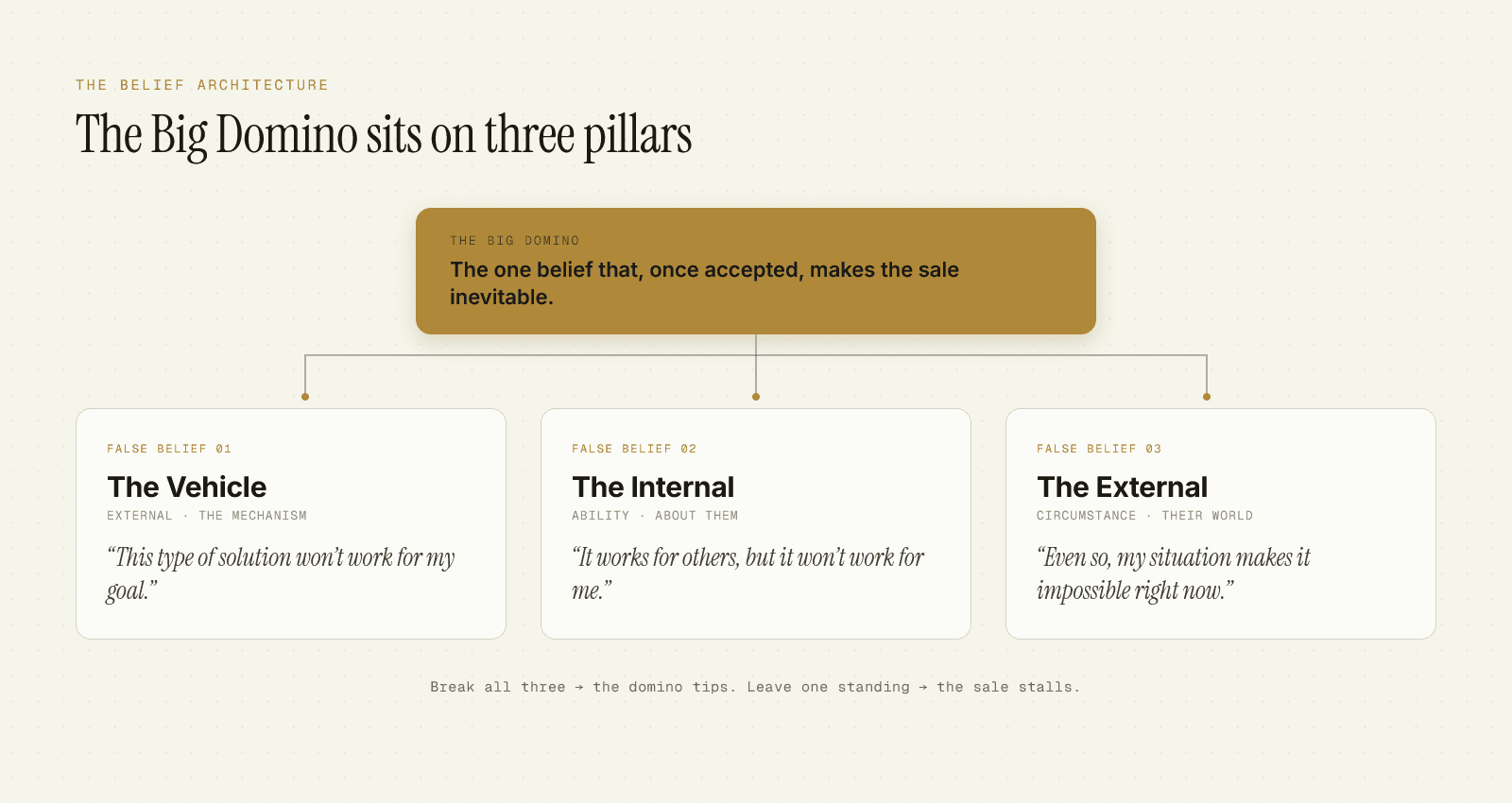
There's one belief that, if your prospect fully accepted it, would make the sale inevitable. Russell Brunson calls this the Big Domino or the One Belief.
Not "I believe this product is good." That's too shallow.
The Big Domino is the fulcrum belief about reality itself. When it tips, everything else falls into place.
Examples:
- Weight loss offer: "The reason I'm overweight has nothing to do with willpower or genetics. It's because my gut biome is destroying my metabolism."
- B2B productivity offer: "The bottleneck in my business isn't my team's effort. It's the fact that every project requires me to be the integrator."
- MarketerX (our product): "The reason my marketing feels inconsistent isn't because I need better prompts. It's because I'm re-teaching my AI the same context every single session."
Notice the structure: the Big Domino reframes the cause of the problem. It shifts the prospect's understanding of why they're stuck.
When someone accepts the Big Domino, they stop looking for solutions in the old category. They start looking for solutions in the new category you just created. And you're the only one selling in that category.
That's the target. Now here's what's blocking it.
The Three False Beliefs (And Why There Are Always Three)
Your prospect doesn't accept your Big Domino because they hold three competing beliefs. Each one is a load-bearing pillar holding up their current worldview.
You have to break all three. If even one remains standing, the sale doesn't close.
Here's the structure:
False Belief #1: The Vehicle (External)
"The mechanism you're selling won't work for this goal."
This is the belief about your solution category itself. Not your specific product. The entire category.
Examples:
- "Keto diets don't work for long-term weight loss." (even though you're selling a keto program)
- "AI writing tools produce generic, off-brand content." (even though you're selling an AI writing tool)
- "Webinars don't convert cold traffic anymore." (even though you're selling a webinar funnel course)
If your prospect believes the vehicle is broken, they won't even evaluate your specific offer. You're selling a Ferrari, and they think cars can't drive.
False Belief #2: Internal (Ability)
"Even if the mechanism works for others, it won't work for me because of something about me."
This is the belief about their own capability, situation, or constraints.
Examples:
- "I don't have the discipline to stick to a diet." (even though they now believe keto works)
- "I'm not a good writer, so I won't know how to edit AI output." (even though they now believe AI tools can be good)
- "I'm too introverted to sell on camera." (even though they now believe webinars convert)
If your prospect believes they lack what it takes, they admire your offer from a distance but never buy. You're selling a guitar to someone who thinks they're tone-deaf.
False Belief #3: External (Circumstance)
"Even if the mechanism works, and even if I'm capable, my situation makes this impossible right now."
This is the belief about external constraints: time, money, support, infrastructure, market conditions.
Examples:
- "I don't have time to meal prep." (even though they believe keto works and they can do it)
- "My team is already overwhelmed. I can't add another tool to their workflow." (even though they believe the tool is good and they're capable)
- "My industry is too saturated for webinars to work." (even though they believe webinars convert and they could present one)
If your prospect believes their circumstances are prohibitive, they agree with everything you've said and still don't buy. You're selling a boat to someone who thinks they live too far from water.
Why This Framework Matters: The Belief Stack Diagnostic
Most copy fails because it breaks one or two false beliefs and leaves the third untouched.
You write 2,000 words proving your mechanism works (Vehicle belief handled), but you never address "I don't have time" (External belief unaddressed). Prospect agrees with you, loves the idea, and ghosts at checkout.
Or you spend the entire sales page on testimonials proving "people like you succeeded" (Internal belief handled), but you never prove the mechanism itself works (Vehicle belief unaddressed). Prospect thinks "sounds great, but I'll try the cheaper competitor first."
The Belief Stack Diagnostic is simple:
- Write down your Big Domino (the one belief that makes the sale inevitable).
- List the three false beliefs blocking it: Vehicle, Internal, External.
- Audit your funnel: which belief are you actually addressing? Which are you ignoring?
Most funnels break two and ignore one. That's why conversion rates sit at 2-4% instead of 8-12%.
How to Break a False Belief Without Triggering Resistance
Here's the mistake: you can't argue someone out of a belief they've held for years.
If your prospect believes "diets don't work," and you say "yes they do, here's proof," you've triggered their defense mechanisms. They dig in. Your proof slides off.
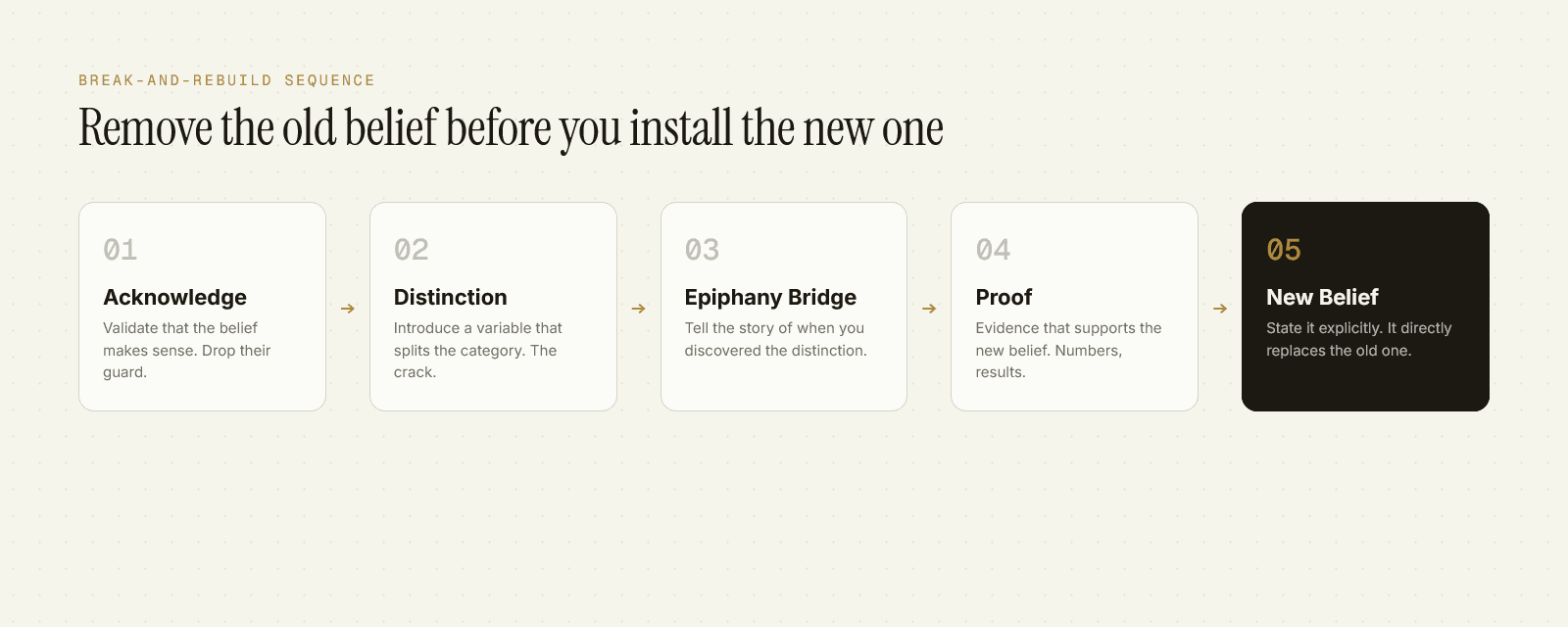
The break-and-rebuild sequence works differently. Five steps:
Step 1: Acknowledge the Belief (Permission)
Start by validating that the belief makes sense given what they've experienced.
Example (Vehicle belief — AI tools):
"You're right to be skeptical of AI writing tools. Most of them do produce generic, off-brand garbage. I've tested 30 of them. Twenty-six sound like they were written by the same intern."
You're not agreeing the belief is true. You're agreeing it's reasonable. That drops their guard.
Step 2: Introduce a Distinction (The Crack)
Show them a variable they didn't know existed. A new dimension that splits the category.
Example:
"Here's what I didn't realize until last year: there's a difference between AI tools that write for you and AI tools that write from you. The first kind replaces your brain. The second kind extends it."
You've introduced a crack in their belief. They thought all AI tools were the same. Now they're considering that maybe there are two types.
Step 3: Epiphany Bridge (The Reframe)
Tell the story of when you discovered this distinction. Make it personal, specific, and recent enough to feel real.
Russell Brunson calls this the Epiphany Bridge. It's the moment you had the realization you're now giving them.
Example:
"I realized this when I was writing a product launch email at 11 p.m. I fed my brand voice doc into the tool, gave it three customer testimonials, and told it the angle I wanted. It came back with something I would've written myself. Not better. Not worse. Just… mine. That's when it clicked: the tool wasn't writing. I was. It was just handling the assembly."
The story does the persuasion work. You're not telling them to believe you. You're inviting them to see what you saw.
Step 4: Proof (The New Evidence)
Now that the reframe has landed, provide evidence that supports the new belief. Testimonials work here. Data works here. Demonstrations work here.
Example:
"Since then, I've watched 600+ marketers use this approach. The ones who feed the tool their brand context first get output they can ship 80% of the time. The ones who treat it like a blank-slate writer get generic sludge 95% of the time. Same tool. Different belief about how to use it."
Step 5: The New Belief (Explicit)
State the new belief clearly so they know what they're accepting.
Example:
"So here's what I believe now: AI writing tools aren't the problem. Contextless AI writing tools are. If you teach the tool your brand once and it remembers, you're not fighting it anymore. You're directing it."
That's the new belief. It directly replaces the old one.
The Belief-Aligned Stack: Matching Your Offer to the Beliefs You Broke
Here's the non-obvious part: your offer components should map to the three false beliefs.
If you break the Vehicle belief (the mechanism works), your core offer should deliver that mechanism.
If you break the Internal belief (you're capable), one of your bonuses should remove the capability gap.
If you break the External belief (your circumstances allow it), another bonus should address the constraint.
Example (MarketerX):
- Big Domino: "The reason my marketing feels inconsistent isn't because I need better prompts. It's because I'm re-teaching my AI the same context every session."
- False Belief #1 (Vehicle): "AI tools produce generic content." → Core offer: Brand-aware AI workspace that remembers your business context.
- False Belief #2 (Internal): "I'm not a good enough marketer to know if the AI's output is good." → Bonus: Built-in Hemon scoring on every asset before delivery.
- False Belief #3 (External): "I don't have time to organize all my brand docs and upload them." → Bonus: One-time brand setup wizard that extracts everything in 15 minutes.
Each offer component directly addresses a belief you broke. The stack isn't random. It's architectural.
Most offers throw in bonuses that sound cool but don't map to beliefs. That's why they don't move conversion rates.
The Diagnostic: Which False Belief Is Killing Your Funnel?
Run this audit on your current offer:
Question 1: Vehicle Belief
Does your sales copy prove that this type of solution works for this type of goal? Or are you assuming they already believe in the category?
If you're selling a webinar course, have you proven webinars still convert? Or did you skip straight to "my webinar course is great"?
If Vehicle belief is unaddressed, your prospect exits at the headline. They never get to your offer.
Question 2: Internal Belief
Does your funnel address "I don't think I can do this"? Have you shown proof that people with their constraints, skill level, or situation succeeded?
If you're selling a done-for-you service, this is less critical. If you're selling a course, a tool, or a program they have to execute, this is load-bearing.
If Internal belief is unaddressed, your prospect loves the idea, saves your page, and never comes back.
Question 3: External Belief
Does your offer remove the external constraint they believe blocks them? Time, money, team support, infrastructure?
If they believe "I don't have time," does your mechanism require less time than their current approach, or does it require more?
If External belief is unaddressed, your prospect agrees with everything, ghosts at checkout, and buys from a competitor six months later when their situation changes.
The Three Most Common Failures
Failure #1: Breaking Vehicle, Ignoring Internal
You prove the mechanism works. You show case studies. You demonstrate results.
But you never address "people like me don't succeed at this."
Your funnel converts people who already believe they're capable. It repels everyone else.
Fix
Add a "people like you" proof section. Testimonials from customers who had the same Internal belief before they started.
Failure #2: Breaking Internal, Ignoring Vehicle
You load up on testimonials. You show social proof. You prove "you can do this."
But you never prove this type of solution works in the first place.
Your funnel converts people who already believe in the category. It repels skeptics.
Fix
Add mechanism education. Teach how the solution works, why it works, and what makes it different from the broken alternatives they've tried.
Failure #3: Breaking Vehicle and Internal, Ignoring External
You prove the mechanism works. You prove they can do it. But your offer requires 10 hours a week, and they don't have 10 hours.
Your funnel converts people whose circumstances already allow the solution. It repels everyone else.
Fix
Redesign the offer to address the constraint, or add a bonus that removes it. If time is the constraint, the offer has to be faster than their status quo.
What This Looks Like in Practice: A Worked Example
Let's map this to a real offer: a $2,000 webinar training for B2B consultants.
Big Domino:
"The reason I'm not closing high-ticket clients consistently isn't because I lack expertise. It's because I'm trying to close on discovery calls, and discovery calls aren't designed to sell."
False Belief #1 (Vehicle): "Webinars don't work for B2B."
"My clients want one-on-one calls, not group presentations."
How to break it:
- Acknowledge: "You're right that most B2B webinars feel like product demos. I've sat through 200 of them. Ninety percent are features and screenshots."
- Distinction: "But there's a difference between a demo webinar and a belief-shift webinar. One educates. The other converts."
- Epiphany Bridge: "I realized this when I ran my first 90-minute belief-shift webinar. I didn't show my software once. I taught my framework. Sixteen people registered. Eleven stayed for the offer. Four bought that day at $8K each. $32K from 90 minutes."
- Proof: "Since then, I've watched 80+ B2B consultants do the same. The ones who teach instead of demo close at 15-25%. The ones who demo close at 2-4%."
- New Belief: "Webinars work in B2B when you use them to shift beliefs, not showcase features."
False Belief #2 (Internal): "I'm not a good presenter."
"I'll freeze on camera."
How to break it:
- Acknowledge: "Most people think they're bad presenters because the only feedback they've gotten is from boring meetings where no one cared."
- Distinction: "Presenting to people who already want to be there is a completely different skill than presenting to people who don't."
- Epiphany Bridge: "I bombed my first three webinars. Then I realized I was trying to perform instead of teach. The moment I treated it like a one-on-one coaching call with 20 people listening, I relaxed. The closes went up."
- Proof: "I've now trained 80 consultants through this program. Sixty-two of them said they were 'bad presenters' before they started. Fifty-four are now running webinars monthly."
- New Belief: "You don't need to be a great presenter. You need a great framework and a script that walks you through it."
False Belief #3 (External): "I don't have an audience."
"I can't fill a webinar."
How to break it:
- Acknowledge: "If you're starting from zero, you're right. You can't fill a webinar with cold LinkedIn outreach."
- Distinction: "But you don't need a thousand people. You need 20 well-qualified registrants. And there's a difference between building an audience and filling a room."
- Epiphany Bridge: "I filled my first webinar with 16 people by messaging 60 past clients and prospects I'd already talked to. No ads. No list. Just intentional outreach to people who already knew me."
- Proof: "Seventy percent of our clients fill their first webinar with under 100 contacts. You don't need a big list. You need the right 20 people."
- New Belief: "You don't need an audience to run a profitable webinar. You need a targeted list of 50-100 people who already know you."
The Offer Stack (Belief-Aligned):
- Core Offer (Vehicle): 90-minute webinar script template + slide deck framework.
- Bonus #1 (Internal): Word-for-word presenter training + live walkthrough of the script so you never have to ad-lib.
- Bonus #2 (External): 60-person outreach list-building guide so you can fill your first webinar in 7 days without ads.
Each component maps to a belief. The stack isn't decorative. It's surgical.
What This Framework Is Built Into
Your funnel doesn't convert because your prospect holds three false beliefs, and you're only breaking one or two of them.
The Vehicle belief says the mechanism doesn't work.
The Internal belief says they can't do it.
The External belief says their circumstances won't allow it.
Break all three, and the Big Domino tips. The sale becomes inevitable.
Ignore even one, and the prospect exits with "I love this, but not right now."
Most marketers treat objections like whack-a-mole. Elite marketers treat them like a three-lock safe. You don't need a hammer. You need the combination.
This is the belief architecture MarketerX runs on every funnel before a single word of copy gets written. The system identifies your Big Domino, maps the three false beliefs, and structures your entire sales argument around breaking them in sequence. What most marketers do manually over six months, MarketerX does automatically in six minutes.